Most people meet the Kangra Valley in summer, on the way to somewhere else. In December the valley is a different place. The haze of the warmer months has gone, the air is clean and sharp, and the Dhauladhar range stands behind the tea gardens so clearly that you could count the gullies in its snow. The crowds are in Manali and Shimla. Here, the mornings belong to wood smoke, frost on the grass and the sound of someone sweeping a courtyard.
In this story33 sections
- Kangra Valley in winter at a glance
- What winter in Kangra actually feels like
- The Dhauladhar: the white wall behind the valley
- Tea country: Kangra’s quiet, historic brew
- What happens to tea in winter
- Birds of the Kangra Valley in winter
- Pong Dam: where the geese come over the Himalaya
- Birds of the valley and the Dhauladhar
- Stone, faith and patience: three places that tell Kangra’s history
- Baijnath Temple
- Masrur rock-cut temples
- Kangra Fort
- Kangra painting: from a family in Guler to a royal court
- Guler, and one remarkable family
- The Kangra style under Sansar Chand
- Painted walls: the murals of Sujanpur Tira
- Nurpur: Krishna and Meera on the walls of a fort
- Pragpur and Garli: India’s first heritage villages
- Monasteries in the valley
- Andretta: an artists’ village in the fields
- The Kangra Valley toy train
- What to eat: Kangri dham and winter food
- A slow four-day plan
- Getting there from Delhi
- What to pack for Kangra in December
- Frequently asked questions
- Does it snow in Palampur in December?
- Is the Kangra Valley good for a Christmas or New Year trip?
- Can I visit tea gardens in winter?
- How many days do I need?
- Where can I see migratory birds near Kangra in winter?
- Is it safe to travel to Kangra in winter?
- Sources and further reading
Kangra is also one of the great art landscapes of India. The hills, streams and slender trees you see from the road are the same ones that appear, in miniature, in some of the most admired paintings ever made in the subcontinent. Winter, with its long clear light and empty roads, is the best season to see the valley and its art together. What follows covers the weather, the mountains, tea, the painters of Guler and Kangra, the painted walls of Sujanpur Tira and Nurpur, the old temples, the food, and the practical details of getting there.
Kangra Valley in winter at a glance
- Where: Kangra district, Himachal Pradesh, roughly 450–500 km north of Delhi. Palampur, Baijnath, Dharamshala and Kangra town are the main bases.
- Height: the valley floor around Palampur sits at about 1,200 metres. The Dhauladhar ridge behind it rises steeply to well over 4,000 metres.
- December weather: clear, sunny days around 12–15°C in the valley; nights close to freezing. Snow usually falls on the high ridge, not in the towns.
- Best for: slow travellers, people who like walking, food and old places, and anyone who wants mountain views without mountain traffic.
- Not for: snow play in the streets (go higher for that) or a packed sightseeing checklist.
What winter in Kangra actually feels like
The honest version first. December in Palampur is cold at night and pleasant by day. A typical winter day starts misty and still, warms up by mid-morning into bright sun that makes a sweater feel like too much, and turns cold again the moment the sun drops behind the hills around five. Night temperatures commonly fall to the low single digits, and frost on the tea bushes is normal in the coldest weeks.
What you will almost certainly see is snow on the Dhauladhar. When a western disturbance passes over Himachal, the upper ridge gets fresh snow while the valley gets rain, and the next clear morning the whole range is white from end to end. That is the view people come for, and winter is when it is sharpest: the air after rain is so clear that peaks which look faint in May appear close enough to touch.
What you probably will not see is snow in Palampur itself. It happens in some years, but it is not something to plan a trip around. If falling snow underfoot is the goal, you need to go higher, towards places like Barot or the upper villages above Dharamshala.
Winter also brings quiet. Many guesthouses are half empty, the roads are free, and the people you meet have time to talk. For a slow trip, that is the real advantage of the season.
The Dhauladhar: the white wall behind the valley
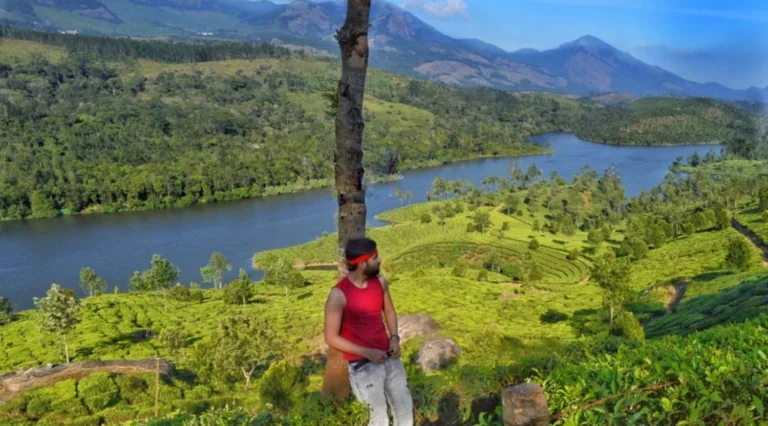
The name tells you what to expect. Dhaula means white and dhar means ridge, so the Dhauladhar is “the white range”. It is one of the outer ranges of the Himalaya, and what makes it remarkable is how suddenly it rises. In most of the Himalaya you have to travel deep into the mountains before the high peaks appear. In Kangra, the valley floor and the snowline are only a short distance apart, so you can stand in a green tea garden at 1,200 metres and look straight up at a wall of rock and snow more than three kilometres higher.
That steepness shapes everything here. Streams come down fast and cold, which is why the valley is full of waterfalls, water channels (kuhls) and old water-powered mills. The slopes catch heavy rain, which is part of why tea grows so well. And the views are not something you drive to: from almost any village lane, you simply look up.
Good places to watch the range in winter light are the tea gardens around Palampur and Holta, the fields near Andretta, and any open hillside at sunrise or just before sunset, when the snow turns pink and then grey.
Tea country: Kangra’s quiet, historic brew
Kangra is one of the oldest tea regions in India, and one of the smallest. Its story begins in the late 1840s, when Dr William Jameson, a British botanist in charge of government botanical gardens in the north, judged that the Kangra slopes were suited to tea and brought China tea plants here. Commercial gardens followed within a few years.
For a while, Kangra tea was famous. In the second half of the nineteenth century it was sold far beyond India and won medals at international exhibitions in London and Amsterdam. Then came a long decline. The 1905 Kangra earthquake (more on that below) damaged estates and factories, many British planters sold up, and over the twentieth century the gardens were divided into many small holdings. Today Kangra produces only a tiny fraction of India’s tea, but what it makes is distinctive: light, fragrant green and black teas with a gentle, slightly sweet character.
Recognition has slowly returned. Kangra tea received a Geographical Indication (GI) tag in India in 2005, and in 2023 it was also registered as a protected geographical indication in the European Union, which means only tea grown and made in this region can be sold under the name.
What happens to tea in winter
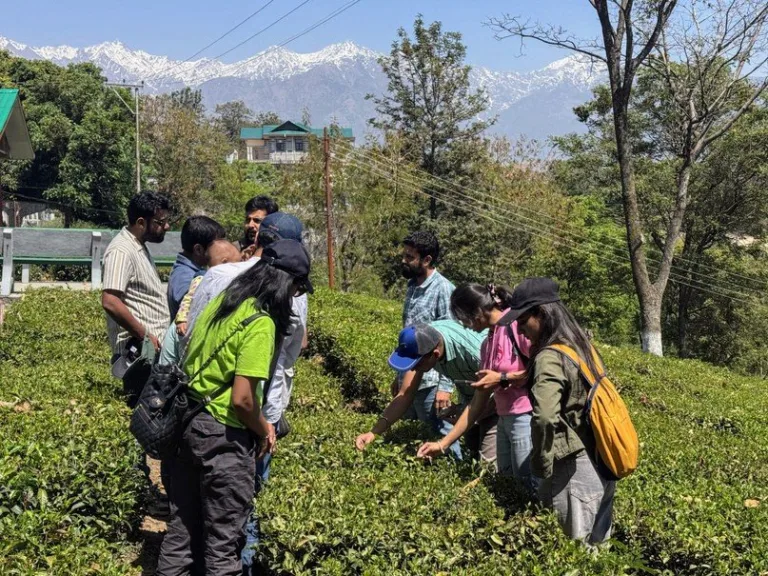
Here is a detail most guides skip. Tea bushes in Kangra rest in winter. The plucking season runs roughly from spring to late autumn, and in the cold months the bushes are pruned and left to recover. So in December you will not see rows of pluckers with baskets. What you will see is the shape of the gardens at their clearest: neat, low hedges running across the slopes, shade trees standing among them, and the snow line above.
It is still a good time to learn about tea. Small factories and co-operatives around Palampur often welcome visitors, and a tasting session, comparing a green tea, a black tea and an oolong-style tea side by side, explains more about Kangra than any signboard. Ask about the “first flush” of spring, which local growers consider their finest tea, and buy a packet to take home.
Birds of the Kangra Valley in winter
Winter is the best season for birds in Kangra, for two reasons. On the slopes, many Himalayan birds that spend the summer high up move down towards the valley as the cold sets in. And at the western end of the district, a huge reservoir becomes one of the most important winter homes for migratory waterbirds in northern India.
Pong Dam: where the geese come over the Himalaya
In the mid-1970s, a large earth dam was built across the Beas near Talwara, at the western edge of Kangra. The lake behind it, officially Maharana Pratap Sagar but known to everyone as Pong Dam or Pong Lake, flooded a wide stretch of valley. Its making came at a real cost: tens of thousands of people from hundreds of villages were displaced, many of them promised land as far away as Rajasthan, and some families are still waiting for their resettlement to be completed half a century later. It is worth remembering that story while you stand on the shore.
The lake also became something no one had planned: a vast winter wetland. Every year, from around October, ducks, geese, grebes and waders arrive from Central Asia, Tibet and Siberia, and stay until about February or March. In good winters the counts run to more than a lakh birds. Pong was declared a wildlife sanctuary, recognised as an Important Bird Area, and in 2002 listed as a Ramsar wetland of international importance, covering more than 15,000 hectares.
The star is the bar-headed goose, a pale grey goose with two black bars on the back of its white head. It breeds on high lakes in Central Asia and Tibet and is famous for migrating straight over the Himalaya, flying higher than almost any other bird. At Pong it gathers in remarkable numbers; one winter census recorded more than 70,000 bar-headed geese on the lake. Watching a flock lift off the water at dawn, honking, and wheel against the snow of the Dhauladhar is one of the great wildlife sights of north India.
Look out too for:
- Northern pintail, elegant ducks with long tails, often among the most numerous birds on the lake.
- Ruddy shelduck, the orange “Brahminy duck”, usually in pairs, with a loud, nasal call.
- Coots, pochards, shovelers and teals in large rafts on open water.
- Great cormorants drying their wings on dead trees and stumps.
- Rarities that bring birders from far away. The red-necked grebe, very rarely seen in India, was first recorded here in 1989.
How to see them: the official birdwatching area is around Nagrota Surian on the lake’s northern side, where mudflats and wet grassland attract the birds. Pong is roughly two hours by road from Dharamshala and a little more from Palampur. Go early in the morning, carry binoculars, keep well back from the flocks, and take a local guide if you can. In winter, as the water level drops, farmers grow crops on the exposed lake bed, and geese often graze in these fields.
Birds of the valley and the Dhauladhar
You do not need to go to Pong to see good birds. A slow morning walk through tea gardens, village lanes or the forests above Dharamshala and Palampur can be full of life:
- Red-billed blue magpie: a long-tailed, bright blue bird that moves through the trees in noisy groups. Impossible to miss.
- Kalij pheasant: a common pheasant of the forest edges, the male glossy blue-black with a crest. Often seen crossing quiet roads at dawn.
- Blue whistling thrush: a dark, shining bird of streams and waterfalls whose loud, human-like whistle carries across the valley early in the morning.
- Laughingthrushes, which travel in chattering parties through the undergrowth.
- Plumbeous and white-capped redstarts, small birds that flick their tails on rocks in fast streams. The white-capped redstart breeds high up and comes down to lower streams and fields in the cold months.
- Lammergeier (bearded vulture), the great vulture of the high Himalaya, which breeds on the cliffs of the Dhauladhar. Scan the ridges on clear days for its huge, diamond-tailed silhouette.
The forests of the Dhauladhar Wildlife Sanctuary above Dharamshala are also home to rarer birds, including the shy cheer pheasant, which birders come specially to look for. For any of these, the first two hours after sunrise are best, and a quiet walk with a pair of binoculars is all you need.
Stone, faith and patience: three places that tell Kangra’s history
Baijnath Temple
About 16 km east of Palampur, the Baijnath temple is dedicated to Shiva as Vaidyanath, the “lord of physicians”. The present stone temple is dated to 1204 CE, and inscriptions inside record that it was built by two local merchants, Ahuka and Manyuka. It is a fine example of the North Indian Nagara style, with a tall curved spire and carved panels that reward slow looking. Morning prayers, when the courtyard is still cold and the bells carry across the town, are the best time to go.
Masrur rock-cut temples
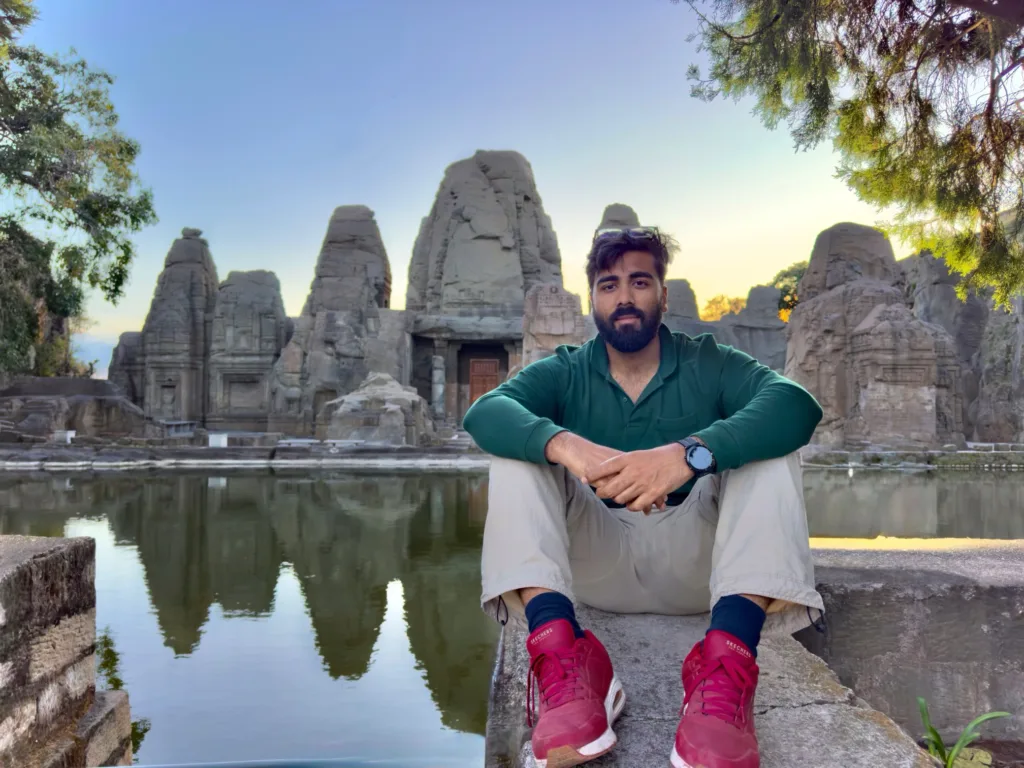
Masrur is one of the strangest places in Himachal, and many visitors to Kangra never hear of it. Here a group of temples was not built but carved out of a single sandstone ridge, most likely in the early eighth century. The complex is often compared to the Kailasa temple at Ellora and is sometimes called the “Ellora of the Himalaya”. Only a handful of monolithic temples of this kind exist in India.
The temples were probably never finished, and earthquakes, including the one in 1905, have damaged much of the carving. Even so, standing on the roof of the rock, with a still water tank below and the Dhauladhar on the horizon, stays with you. The site was brought to the attention of archaeologists by Henry Shuttleworth in 1913 and is protected by the Archaeological Survey of India. Winter light, low and golden, suits it perfectly.
Kangra Fort
On a rocky spur above the meeting of two rivers stands Kangra Fort, seat of the Katoch dynasty, which is said to be one of the oldest royal families in India. No one knows exactly when the fort was first built, but it is counted among the oldest forts in the country and is the largest in the Himalaya. Over the centuries it was besieged, captured and recaptured by Mughal armies, the Gorkhas, the Sikhs and finally the British.
The fort’s long run ended not in battle but on the morning of 4 April 1905, when an earthquake of about magnitude 7.8 struck the valley. More than 20,000 people died across the region, Kangra town was devastated, and much of the fort collapsed. Walking up through its gates today, past cracked walls and broken temples, you see both how strong the place was and how fragile this landscape can be.
Kangra painting: from a family in Guler to a royal court
If you have ever seen an Indian miniature of Radha and Krishna in a moonlit grove, drawn with fine, unhurried lines, soft greens and an air of tenderness, there is a good chance it came from this valley or was made in its style. Art historians group these works as Pahari painting, painting of the hills, a tradition that flourished from the seventeenth to the nineteenth century in small hill kingdoms such as Basohli, Guler, Nurpur, Chamba, Mandi and Kangra. Its most celebrated phase carries the name of Kangra.
Guler, and one remarkable family
The story begins in Guler, a small hill state at the western edge of the valley, near today’s Haripur. In the early eighteenth century a painter called Pandit Seu worked here with his family. His two sons, Manaku and Nainsukh, became two of the most important artists in the history of Indian painting.
Manaku stayed close to home and to his father’s style, with strong colour and bold, decorative compositions. Nainsukh went another way. Around 1740 he left Guler for the small court of Jasrota, and for nearly twenty years worked for a young prince, Raja Balwant Singh (1724–1763). The paintings he made there are unlike anything before them in India: the raja listening to musicians, inspecting a horse, writing a letter, being shaved, warming himself by a fire on a winter night. They are intimate, observant, sometimes gently funny, and they borrow the refinement of Mughal portraiture while keeping the warmth of the hills. Several of them are now in museums such as the Metropolitan Museum of Art in New York and the Victoria and Albert Museum in London. After Balwant Singh’s death, Nainsukh moved to Basohli, and his sons Nikka and Ranjha went on to work for the raja of Chamba. Through these sons, nephews and pupils, the family’s way of seeing spread to court after court across the hills.
The Kangra style under Sansar Chand
The style reached its height under Raja Sansar Chand Katoch, who ruled Kangra from the mid-1770s to the 1820s. A devoted follower of Krishna and an ambitious patron, he gathered painters at his courts, including at Tira Sujanpur, and commissioned large sets of illustrated manuscripts. The favourite subjects were the Bhagavata Purana, with its stories of Krishna’s childhood among the cowherds, and Jayadeva’s love poem the Gita Govinda, about Radha and Krishna. Painters also illustrated poems on the months of the year (baramasa) and on the moods of heroines in love (nayikas), alongside portraits of the raja and his court.
The look of a Kangra painting is easy to recognise once you know it: graceful figures with long faces and fine profiles, rhythmic lines, cool greens and blues, rivers drawn as silver ribbons, and hillsides that fade into soft pink in the distance. The pigments were made from minerals and plants, applied in thin layers with very fine brushes and often burnished to a gentle sheen.
What makes it special for a visitor is how local it is. The rolling hills, the line of trees along a stream, the white peaks on the horizon and the soft winter light in these pictures are this valley. Spend an afternoon walking through Kangra and then look at a book of the paintings, and the connection is obvious. The Kangra Art Museum in Dharamshala holds a collection of miniatures and local crafts, and a few artists in the valley still paint in the old manner.
Painted walls: the murals of Sujanpur Tira
Miniatures were made for royal albums, to be looked at in the hand. Kangra’s rulers also covered walls with painting, and the best place to see what remains is Tira Sujanpur, on the river Beas south-east of Palampur, now in Hamirpur district. This was Sansar Chand’s favourite seat. He turned an old garrison on the hill (the tira) into a palace-fort, and laid out below it one of the largest open grounds in the hills, the Chaugan.
Around the Chaugan stand temples from his reign. The most important for art is the Narbadeshwar temple, a Shiva temple built in 1802 by one of his queens, Rani Prasanni Devi. Its walls are painted with scenes from the Ramayana and the Mahabharata, stories of Shiva, and birds, animals and floral borders, in the same graceful style as the court miniatures. Many of the paintings have faded and some are damaged, but standing inside, in the cold winter light, you can still follow the stories panel by panel. Wall paintings of this kind, known locally as bhitti chitra, once decorated palaces and temples all over Kangra; only a few survive.
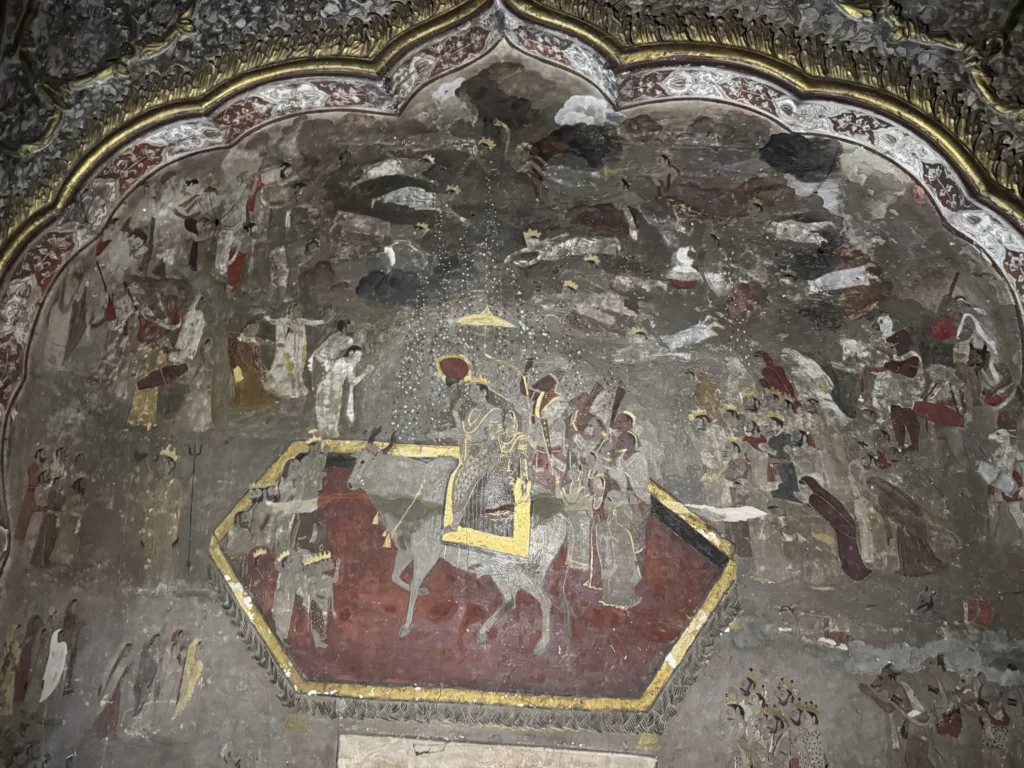
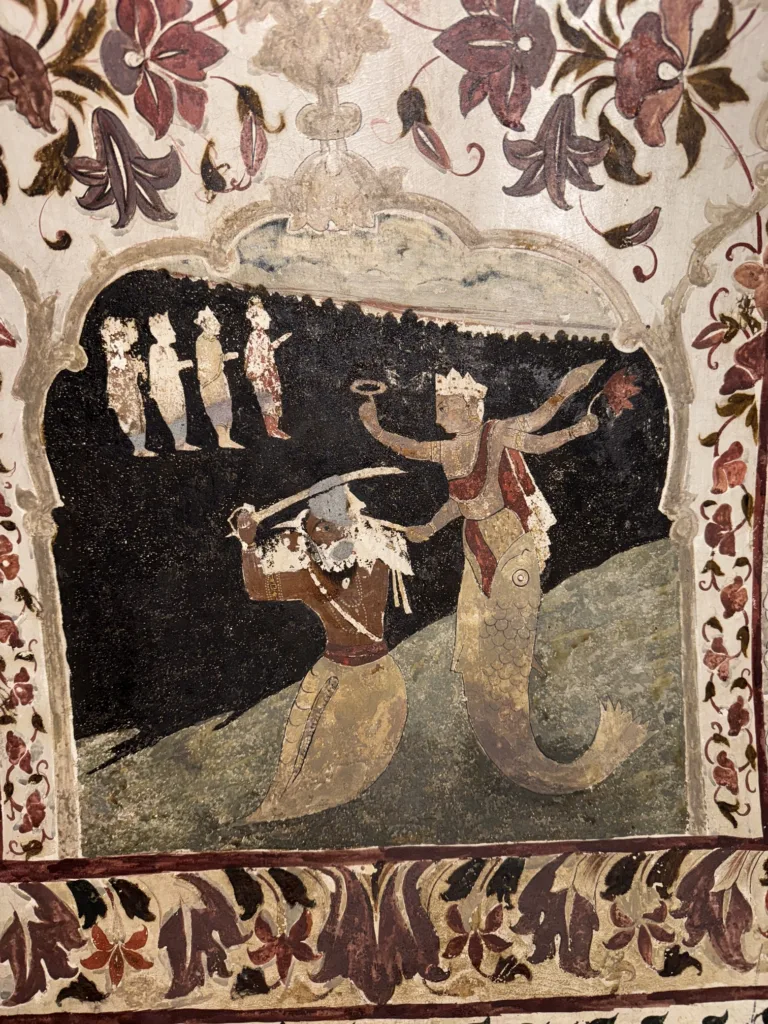
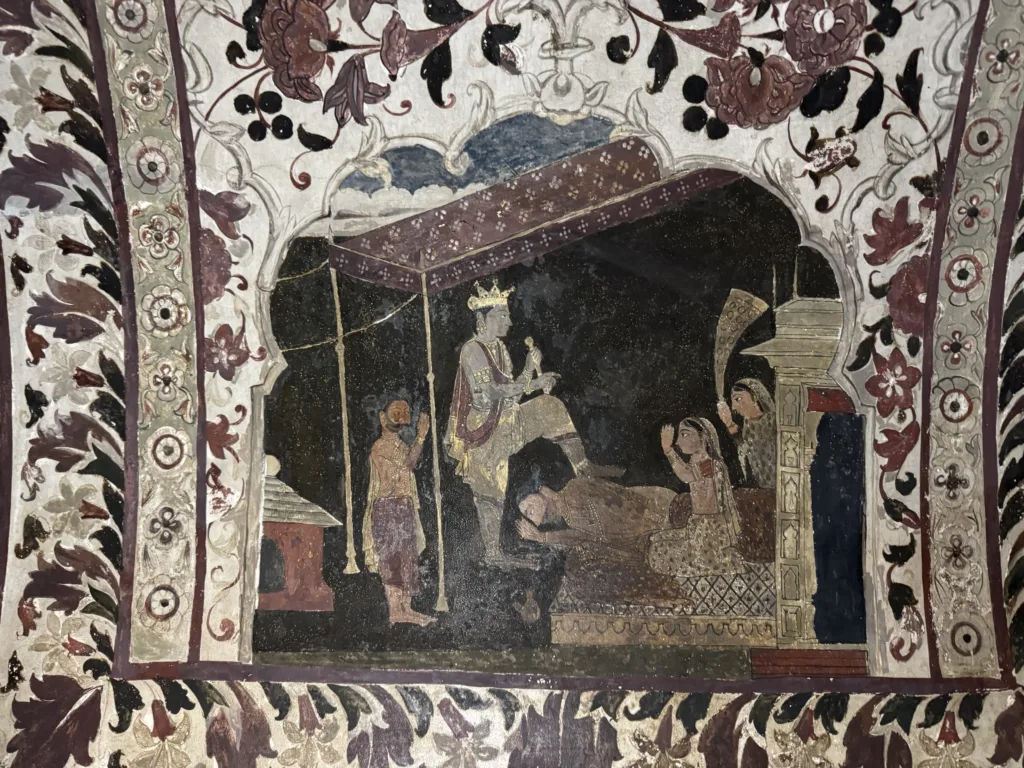
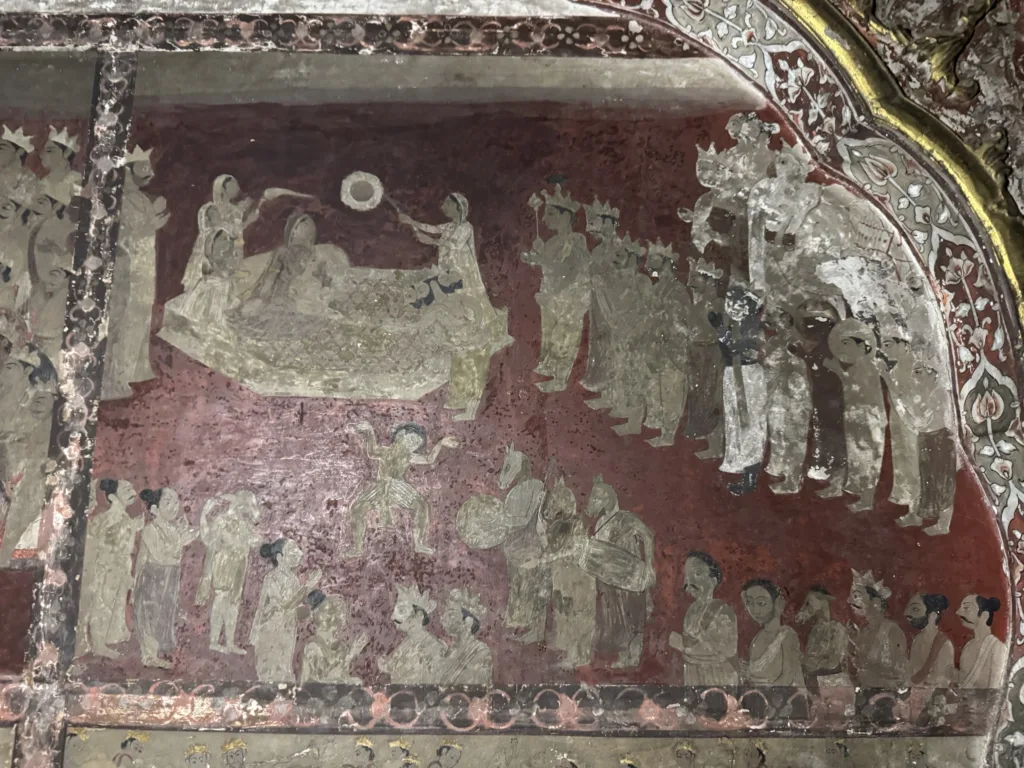
Nearby are the Gauri Shankar temple, built by Sansar Chand in memory of his mother, and the Murli Manohar temple beside the Chaugan, dedicated to Krishna. The raja is also remembered for making Holi at Sujanpur a great public festival, modelled on the Holi of Braj, and a large Holi fair is still held on the Chaugan every year. In winter there is no fair, which is exactly why it is a good time to come: the ground is empty, the temples are quiet, and you can take your time with the walls. Much of the palace above was damaged in the 1905 earthquake, and its ruins look out over the Beas.
Nurpur: Krishna and Meera on the walls of a fort
At the far western end of Kangra district, the town of Nurpur keeps another unusual piece of the valley’s art. Inside the ruined Nurpur Fort stands the Brij Raj Swami temple, which was once a royal audience hall (diwan-e-khas) before it was turned into a temple in the seventeenth century under Raja Jagat Singh. According to a popular local story, the raja brought the black stone image of Krishna back from Chittorgarh in Rajasthan. What makes the shrine rare is that Meera, the poet-saint who devoted her life to Krishna, is worshipped here beside him.
The walls and arches are painted with Krishna’s raas leela, the circle dance with the gopis, and other episodes from his life. Like the murals at Sujanpur, they have faded with time, but they are a reminder that in these hills devotion, poetry and painting were never far apart. From the fort’s broken walls there are wide views over the plains towards Punjab.
Pragpur and Garli: India’s first heritage villages
On the southern side of the district, the twin villages of Pragpur and Garli show a different side of Kangra’s past. They grew rich on the trade of the Sood merchant community, who built large mansions with carved doors and windows, courtyards and pillared verandas, many in a mixed style that combines local, Mughal and colonial ideas. Pragpur has cobbled lanes, a village tank and old shops around it. In December 1997 the Himachal Pradesh government declared Pragpur a heritage village, the first in India, and Garli, about three kilometres away, shares that status. Some of the mansions are well kept, others are slowly decaying, and walking through both villages in the winter sun is a lesson in how wealth, taste and time shape a place.
Monasteries in the valley
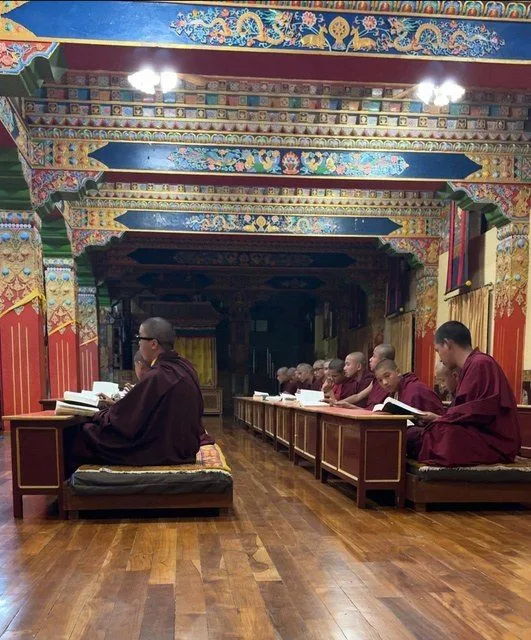
After 1959, many Tibetans settled in Kangra, and the valley now has some of the most peaceful monasteries in India. Two are easy to visit on a slow trip:
- Tashi Jong, between Paprola and Taragarh, about 15 km from Palampur, is a Drukpa Kagyu monastery and a living Tibetan refugee community. Visitors are welcome to sit quietly during prayers.
- Palpung Sherabling, on the road between Baijnath and Bir, was founded in 1975 and is the seat in exile of the Tai Situpa, one of the senior lamas of the Karma Kagyu tradition. Its grounds are set in pine forest, and in winter the place is almost silent.
A few simple courtesies go a long way: walk clockwise around shrines and stupas, ask before photographing people, dress modestly and keep your voice low in prayer halls.
Andretta: an artists’ village in the fields
A few kilometres from Palampur, Andretta is a small village with an unusual history. In 1924 the Irish actor and theatre pioneer Norah Richards, who had championed Punjabi drama in Lahore, made her home here and turned it into a gathering place for writers, painters and theatre people. Artists followed, and the village is still known for its pottery studio, where you can watch potters at the wheel and sometimes try it yourself, and for the homes and work of the painters who settled here. It is a lovely place for a slow winter walk, with mud-and-slate houses, open fields and the Dhauladhar filling the sky.
The Kangra Valley toy train
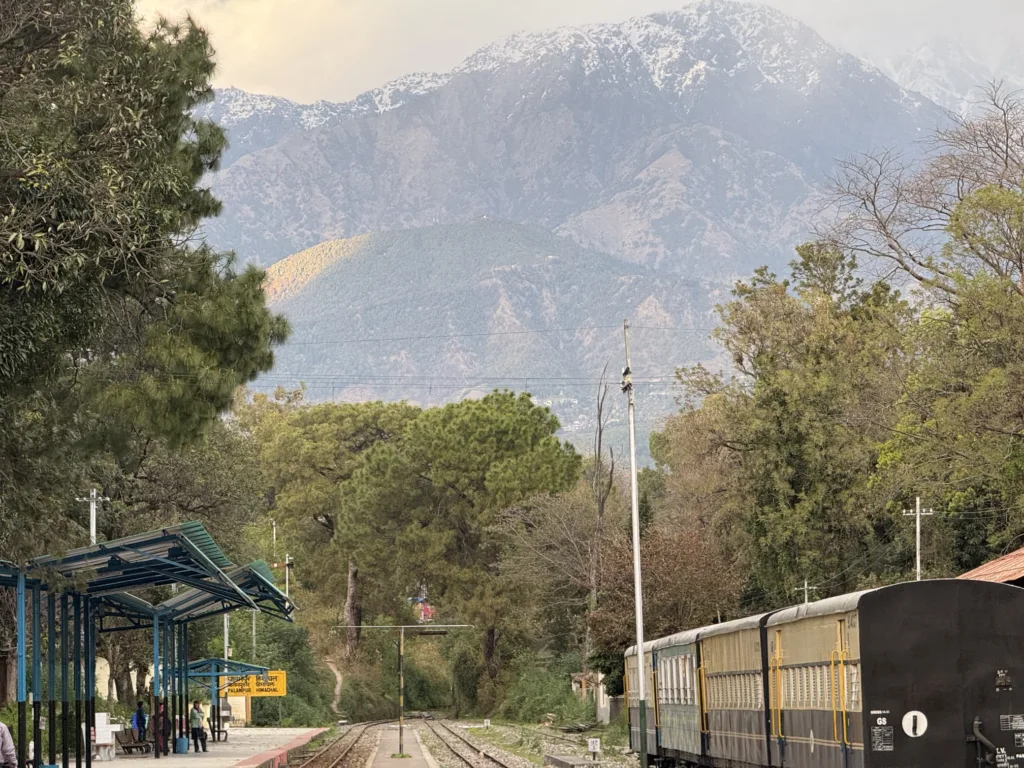
One of the oldest mountain railways in India runs through this valley. The Kangra Valley Railway, a narrow-gauge line (2 ft 6 in) about 164 km long, connects Pathankot to Joginder Nagar and opened to passengers in 1929. It winds through tea gardens, river gorges and small stations, with the Dhauladhar in view for much of the way. Services have been interrupted in recent years by landslides and repairs, so check the running status before you plan around it. When it is running, even a short stretch, for example around Palampur and Baijnath, is a slow, happy way to see the valley.
What to eat: Kangri dham and winter food
If you only eat one meal in Kangra, make it a Kangri dham. A dham is a festive vegetarian feast cooked for weddings, festivals and village gatherings. It is prepared by hereditary cooks called botis in large brass vessels, and served to guests sitting in rows on the floor, on plates made of stitched leaves (pattal). The dishes arrive one by one, in a fixed order, and the server keeps coming back until you stop him.
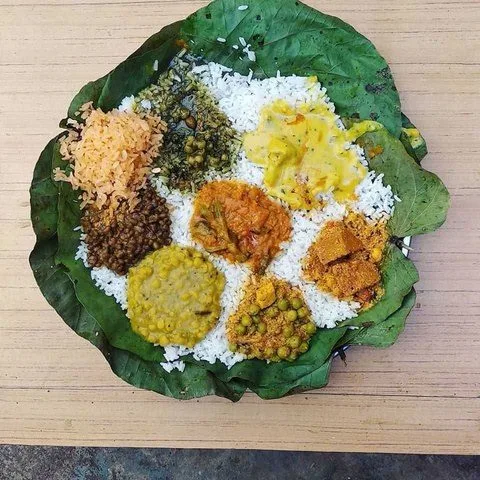
Dishes you are likely to meet:
- Madra: chickpeas or kidney beans slow-cooked in yoghurt with spices. Rich, mild and the heart of the meal.
- Maash dal: a thick, buttery black lentil dal.
- Khatta: a sour dish, often made with chickpeas and tamarind or dried mango, to cut through the richness.
- Kadhi: yoghurt and gram-flour curry, Himachali style.
- Meetha bhaat: sweet rice, often with dry fruit, to finish.
Eating with your hands, sitting cross-legged in a row with strangers, is part of the experience. Accept the second helping; it is polite.
Beyond the dham, winter is a good season for simple village food: thick makki rotis, saag, local rajma, home-made pickles, and endless cups of tea, sometimes salty Tibetan butter tea if you are near a monastery. In the bigger towns, small cafés have become a winter tradition of their own: a sunny terrace, a pot of Kangra tea and a long view of the snow.
A slow four-day plan
Kangra rewards slowness. If you have four days, here is one relaxed way to spend them from a base in Palampur, with a day for the art of the lower valley:
- Day 1, tea and the mountains: walk through the tea gardens around Palampur, visit a small factory or co-operative for a tasting, and watch the last light leave the Dhauladhar.
- Day 2, villages and monasteries: Andretta in the morning, Baijnath temple and Tashi Jong or Sherabling in the afternoon.
- Day 3, painted walls: drive to Tira Sujanpur for the Narbadeshwar murals and the Chaugan, with Pragpur and Garli on the way back if you start early.
- Day 4, stone, history and birds: Masrur’s rock-cut temples and Kangra Fort, or an early start for the winter waterbirds at Pong Dam, with Nurpur on the way if you are heading towards Pathankot.
Getting there from Delhi
- By train: overnight trains run from Delhi to Pathankot. From Pathankot, take a taxi (about three to four hours to Palampur) or the toy train when it is running.
- By bus: overnight Volvo and state buses run from Delhi to Dharamshala and Palampur, usually 10–12 hours.
- By air: Kangra (Gaggal) airport, near Dharamshala, has flights from Delhi. From there Palampur is about an hour by road.
- By car: roughly 10–12 hours via Chandigarh and Una or Pathankot. Start early; winter evenings come fast.
Around Christmas and New Year, trains and buses fill up early, so book at least two to three weeks ahead.
What to pack for Kangra in December
- Thermal inner layers, a fleece or warm sweater, and a proper winter jacket for evenings.
- Comfortable walking shoes with grip, for forest trails and village lanes.
- A warm cap, gloves and woollen socks. Nights are colder than the sunny days suggest.
- Sunscreen and sunglasses. The winter sun at this height is strong.
- Socks you do not mind showing: you will take your shoes off at temples, monasteries and homes.
- Binoculars, if you can carry them, for the birds at Pong and in the forests.
- Cash in small notes for village shops, tea and donations.
Frequently asked questions
Does it snow in Palampur in December?
Snow regularly falls on the Dhauladhar range above Palampur in winter, but snow in the town itself is uncommon. Expect clear sunny days, cold nights and snow-covered peaks in view.
Is the Kangra Valley good for a Christmas or New Year trip?
Yes, especially if you want quiet. It is far less crowded than Shimla or Manali at that time, the views are at their clearest, and it is an overnight journey from Delhi.
Can I visit tea gardens in winter?
You can walk through the gardens and visit factories and co-operatives for tastings, but the bushes are resting and pruned in winter, so there is no plucking until spring.
How many days do I need?
Three to four days is ideal for Palampur and the nearby villages, temples and monasteries without rushing.
Where can I see migratory birds near Kangra in winter?
At Pong Dam (Maharana Pratap Sagar), a Ramsar wetland about two hours from Dharamshala. Waterbirds, including large flocks of bar-headed geese and northern pintail, stay from about October to February or March. The Nagrota Surian area on the northern shore is the main viewing spot.
Is it safe to travel to Kangra in winter?
Generally yes. Roads in the valley stay open; only the high passes close. Check the forecast for western disturbances, which can bring a day or two of rain and colder weather.
Sources and further reading
- Tea Board of India and reports in The Tribune and ThePrint on Kangra tea’s history, GI tag (2005) and EU protected geographical indication (2023).
- Archaeological Survey of India and Himachal Pradesh Tourism on the Masrur rock-cut temples, Baijnath temple and Kangra Fort.
- Kangra district administration and Indian Railways on the Kangra Valley Railway (opened 1929).
- Ramsar Sites Information Service (Pong Dam Lake, site 1211), BirdLife International Important Bird Area and Key Biodiversity Area factsheets for Pong Dam Lake and the Dhauladhar Wildlife Sanctuary, Himachal Pradesh Forest Department winter waterbird censuses reported in The Tribune, and Down to Earth on the Pong Dam displaced.
- Historical accounts of the 1905 Kangra earthquake (USGS; 1911 Encyclopaedia Britannica).
- The Metropolitan Museum of Art and the Victoria and Albert Museum (paintings by Nainsukh for Raja Balwant Singh of Jasrota); B. N. Goswamy’s studies of Nainsukh and the Guler family of painters.
- Writing on Pahari and Kangra painting under Raja Sansar Chand, including Karl Khandalavala’s Pahari Miniature Painting.
- Reports in The Tribune on the Narbadeshwar temple murals at Tira Sujanpur and the Brij Raj Swami temple at Nurpur; Himachal Pradesh government notification of Pragpur as a heritage village (1997).